
John Knox MacArthur (14 January 1891—20 July 1918) was born in Columbia, Lancaster County, Pennsylvania. He, his siblings, and his parents, Charles and Mary, lived at 303 Chestnut Street. At about the age of ten, the family moved to Harrisburg, but soon relocated to Buffalo, New York. Prior to joining the US Army Air Service, 27th Aero Squadron, John was employed as an electrical engineer. Yet, before WWI ended, he achieved a supreme honor: becoming his squadron’s first flying ace (shooting down 5 or more enemy planes). He is credited with six aerial victories.
“Mac” (as his friends called him) was a graduate of Yale University. He was trained by officers of the Royal Flying Corps at Fort Worth, Texas. John joined the United States Air Service in 1917 and was sent to France in February 1918.
Lieutenant MacArthur downed his half dozen German planes during 13-19 July 1918. That’s impressive enough, but that included a pair of Fokker D.VIIs—German planes designed by Reinhold Platz and known for their speed and superior maneuverability. John MacArthur also shot down two Rumpler Cs, an Albatros D.V, and one other unrecorded.
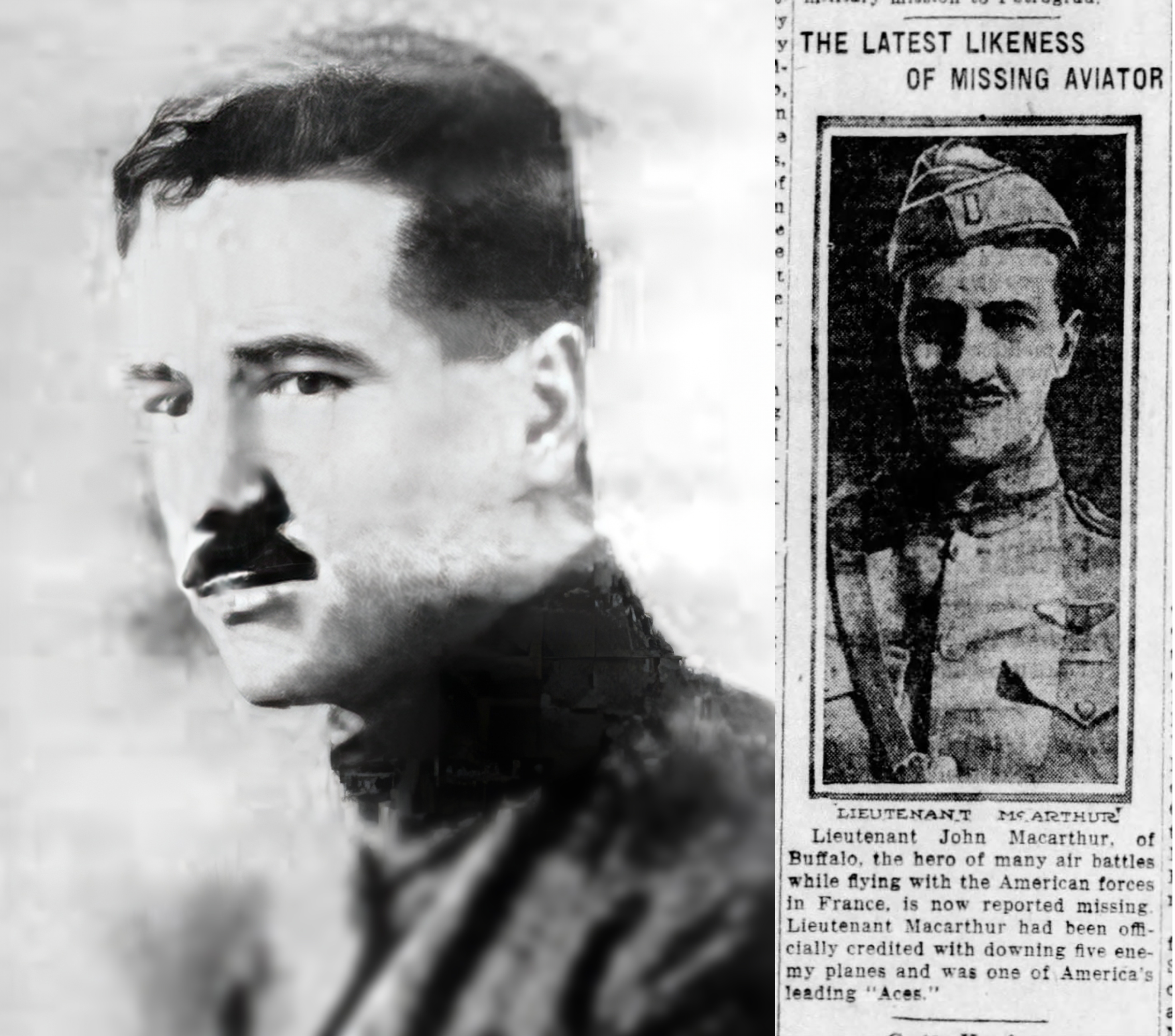
However, that accolade was short-lived. A day later, 20 July, he was one of three pilots forced down by lightning, cross winds, and heavy rains. In the process, he was wounded by the Germans and, ultimately, captured. He was moved to a hospital facility, but eventually died of his wounds. One newspaper reported that he died in a prisoner of war camp.
Having scored all of his dramatic victories flying the Nieuport 28 (a French biplane fighter aircraft), he was one of the most successful pilots using this aircraft type. For his skills and bravery, John was a recipient of the Prisoner of War Medal, the United States Aviator Badge, the World War I Victory Medal, the Purple Heart, the French Croix de Guerre, and the Distinguished Service Cross.
His Distinguished Service Cross award reads: The Distinguished Service Cross is presented to John Knox MacArthur, Second Lieutenant (Air Service), U.S. Army, for extraordinary heroism in action near Luneville, France, July 13, 1918. Outnumbered and handicapped by his presence far behind the German lines, Second Lieutenant MacArthur and three flying companions fought brilliantly a large group of enemy planes, bringing down or putting to flight all in the attacking party, while performing an important mission.
A true hero by any measure.
At the young age of 27, John Knox MacArthur was surely among the most brave and capable during this conflict. America (and Columbia) should feel proud and appreciative of his efforts and tenacity.
He is buried at Wilmington and Brandywine Cemetery, Wilmington, Delaware, USA.

 CHPS
CHPS 