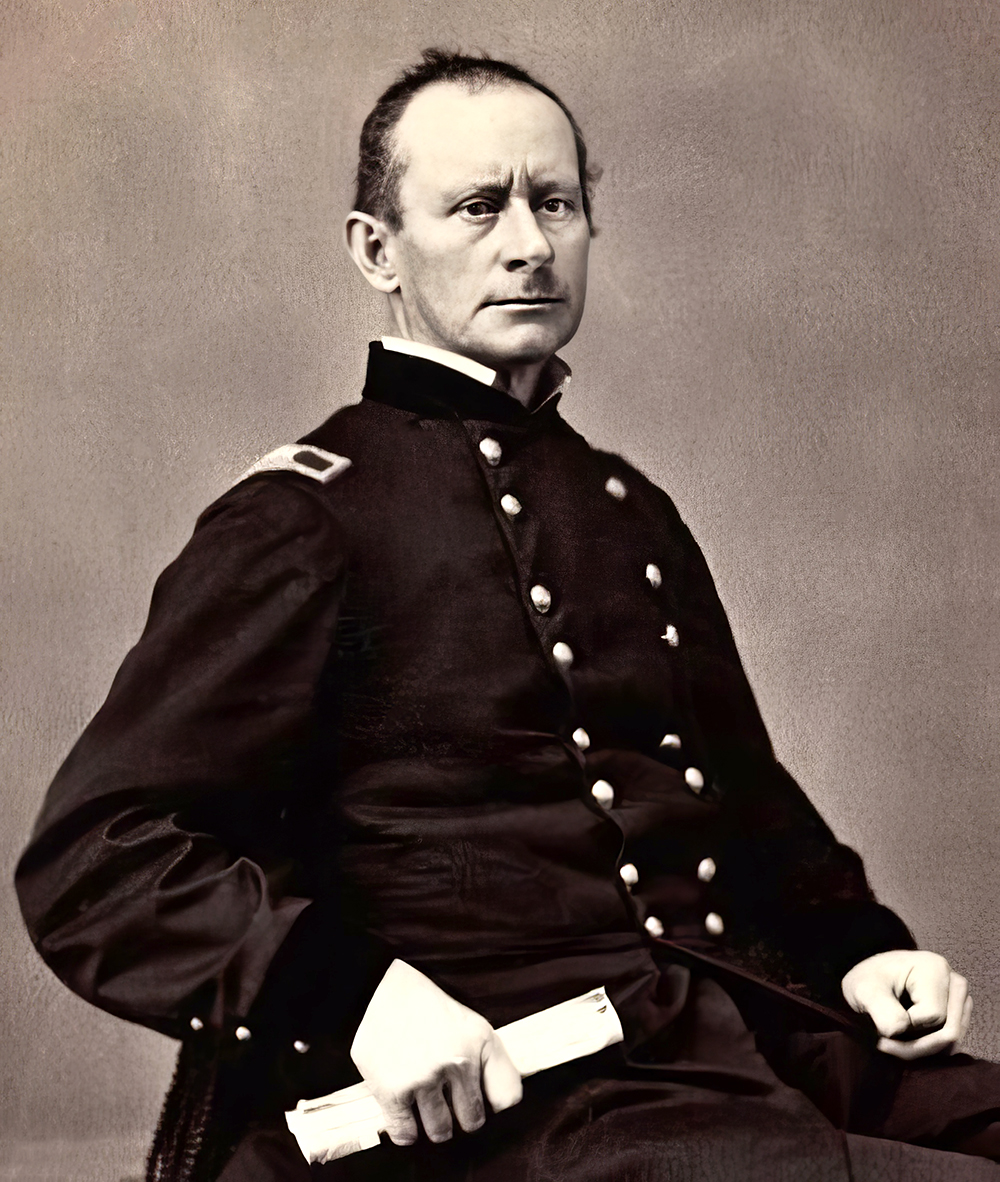
Brevet Brigadier General Joseph Washington Fisher (16 October 1814–18 October 1900) was born in Northumberland, Northumberland County, Pennsylvania. He was educated in the local schools and, later, studied law, passing his bar exam. Licensed as an attorney, he established a profitable legal practice serving the Northumberland County area. As a boy, his family had moved to Columbus, Warren County, but moved to Lancaster in 1840 with his wife of four years, Elizabeth ‘Emma’ Shearer.
He served as a member of the Pennsylvania House of Representatives, 1848-1849, but refused re-election owning to his refusal to support Thaddeus Stevens. Some time before this, he relocated to Columbia, Pennsylvania where he was elected Justice of the Peace and served, 1850-1855. He and his family was said to have taken a house, three houses east of the northeast corner of Second and Walnut Streets—the same house once occupied by Columbia’s own, General Thomas Welsh.
He enlisted, 15 May 1861, at the rank of Captain, 34th Regiment, Pennsylvania Volunteer Infantry, 5th Pennsylvania Reserves. A month later, he was promoted to Lieutenant Colonel after Colonel Seneca G. Simmons was killed in action at the Battle of Glendale during the Seven Days Battles, Richmond, Virginia. At the Battle of Second Manassas, known as Bull Run, he was promoted to Full Colonel for meritorious conduct while sustaining serious wounds when his horse was shot out from under him at full gallop.
Fisher commanded the 5th Reserves during the Battle of Antietam, forcing a Confederate retreat. He performed gallantly at the Battle of Fredericksburg, Reserves Division, under the command of Major General George G. Meade. The Reserves were removed from the field to recover from hard service in 1862 when Fisher took command of the brigade in the XXII Corps, Department of Washington.
When the two brigades of the Reserves returned to the field in 1863, they were commanded by Brigadier General Samuel W. Crawford. Colonels Joseph W. Fisher and William “Buck” McCandless (member, Pennsylvania State Senate, 1st district, 1867-1869) led these units in the V Corps at the Battle of Gettysburg on the left flank of the army. Fisher figured prominently when he was the first to ascend Little Round Top late on 2nd July 1863.
Joseph Fisher saw action at the Wilderness when he left his sick bed against a surgeon’s orders to participate at Mine Run in November 1863, and Spotsylvania Court House. At the Battle at Charles City Crossroads, he led the famous charge that shattered the enemy. Joseph Fisher’s last action as brigade commander was at the Battle of Cold Harbor. He was mustered out three days later, 15 June 1864.
Gen. Fisher returned to service at Lancaster, Pennsylvania as a Colonel, 195th Regiment, Pennsylvania Volunteer Infantry, 100-day service, commanding his regiment at Shenandoah Valley, Virginia. He was promoted to Brevet Brigadier General, United States Volunteers, 4 November 1865, by President Grant. He finally left service, 31 January 1866. After returning home, he was elected to, and served in, the Pennsylvania State Senate for the 17th district, 1867-1868.
In 1871, Fisher was appointed Chief Justice of the Wyoming Territory Supreme Court by President Ulysses S. Grant—a ten-year term. After his term, he was appointed United States Commissioner for the Wyoming Territory, serving in that capacity until statehood in 1890.
Joseph Fisher died in Cheyenne, Wyoming and is buried in Lakewood Cemetery.

 CHPS
CHPS 